
How to Become an Air Traffic Controller
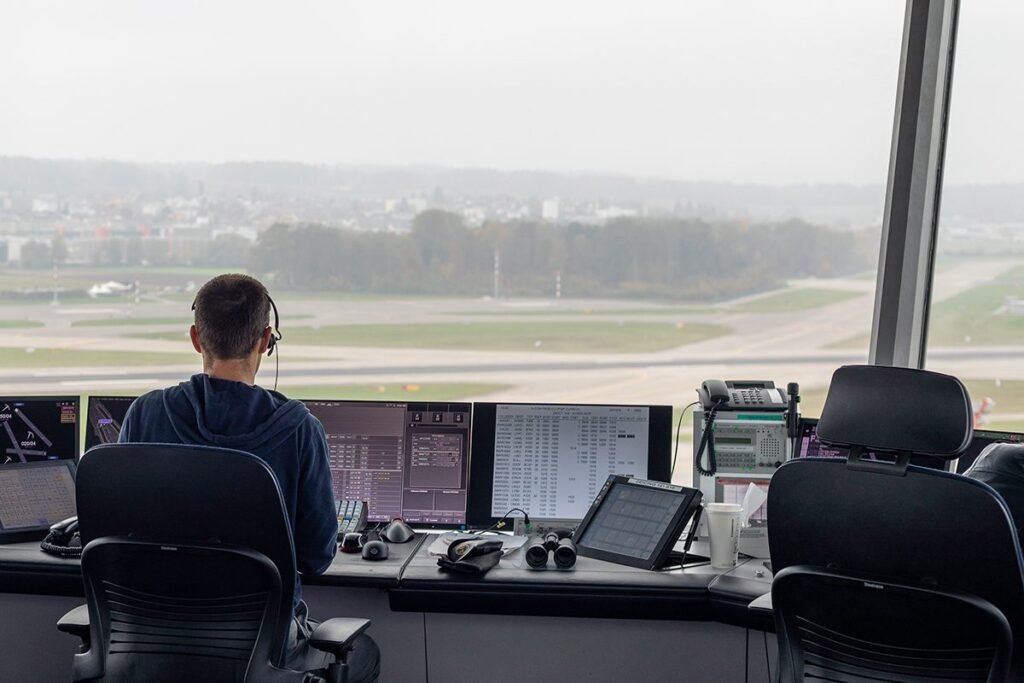

Here is how to become an air traffic controller in the US: apply to the FAA during a hiring window before your 31st birthday, pass the Air Traffic Skills Assessment, clear medical, psychological and security checks, then graduate from the FAA Academy in Oklahoma City and certify at a facility. No college degree is required. BLS put the median pay at $148,080 in May 2025, and the FAA is hiring at a record pace.
Eligibility: under 31, US citizen, English speaker
The FAA’s public announcement sets a short list of hard requirements:
- Age. You must be under 31 when you apply. Controllers face mandatory retirement at 56, and the cap leaves time for a full career. Narrow exceptions exist for applicants with prior air traffic control experience, such as military controllers.
- Citizenship. US citizens only.
- Language. You must speak English clearly enough to be understood over the radio.
- Experience or education. The general public announcement asks for three years of progressively responsible work, a four-year degree, or a mix of college and work. Any field counts.
- Checks. A medical exam, a psychological evaluation, drug testing, fingerprints and a federal background investigation.
The resume matters more than people expect. The announcement asks for one of up to two pages, with dates and hours per week for each job. Vague entries can knock an application out before the test.
Three ways in: public hiring, AT-CTI and the military
Most applicants come in through the annual public announcement on USAJobs. The 2026 window opened at midnight on April 17 and closed once the FAA had 8,000 applications, so the people who applied in the first hours had the best chance. Hangar jobs follow a different path entirely: an aircraft mechanic trains at a Part 147 school or on the job, with no age cap.
The second route is the Air Traffic Collegiate Training Initiative, a network of colleges with aviation programs. The FAA expanded it in 2025 as the Enhanced AT-CTI, letting graduates of qualifying programs go straight to a facility instead of through the Academy.
The third route is the military. Veterans with controller experience can be hired directly under on-the-spot authority, and they get a preferred list of larger facilities.
The ATSA: 3.5 hours at a Pearson VUE center
The Air Traffic Skills Assessment is a computer test of about three and a half hours, taken in person at a Pearson VUE testing center. It doesn’t test aviation knowledge. It measures memory, multitasking, spatial reasoning, quick math, attention under pressure and how you handle a simple air traffic scenario game where you move aircraft without conflicts. A work-style questionnaire rounds it out.
Results come back as categories, and you need “Well-Qualified” to move forward. You can’t memorize answers, but practice helps with speed: mental math, pattern games and anything that trains you to track several moving things at once. Applicants who play strategy or flight games often find the scenario section familiar. The FAA itself pitched its 2026 recruiting campaign at young adults who game.
Medical, psych and background
A tentative offer follows a good ATSA result, then the clearances. The medical exam covers vision, hearing, heart health and medications; some conditions that wouldn’t stop a private pilot can stop a controller. The psychological evaluation looks at stress tolerance. The background check covers employment, finances and any criminal record.
In 2025 the FAA added medical staff to speed this stage and cut its hiring process from eight steps to five. Even so, months can pass between the test and the Academy start date.
FAA Academy in Oklahoma City
Training at the FAA Academy at the Mike Monroney Aeronautical Center takes several months, depending on the track you’re assigned: terminal, which covers towers and approach control, or en route, which covers the large centers handling high-altitude traffic. Trainees start at $22.61 an hour, with health and housing benefits.
The Academy is pass-fail and not everyone passes. Lessons cover regulations, phraseology, separation standards and aviation weather, then move to simulator problems that grow in traffic and complexity. Graduates who finish initial qualification receive a $5,000 bonus, and those sent to one of 13 hard-to-staff facilities receive $10,000.
After the Academy comes on-the-job training at the assigned facility, often 1 to 3 years before full certification. You list your preferences, but the FAA decides where you go. A trainee who wanted a tower in Colorado may end up at a center in the Midwest.
Pay once certified
BLS put the median at $148,080 in May 2025, and the FAA says certified controllers average more than $155,000 a year within three years of leaving the Academy. Pay depends on the facility level: busy centers and approach controls pay more than a quiet tower, and locality pay adds to it in expensive regions. Overtime is common at short-staffed facilities.
The retirement system is unusual. Controllers can retire at 50 with 20 years of service, or at any age with 25, and must leave at 56. Since 2025, controllers eligible to retire who keep working receive a lump sum of 20 percent of basic pay for each extra year.
For comparison, that median is lower than the median pilot salary at the airlines but arrives much faster, without six figures of training debt. A controller doesn’t pay for the Academy; an airline pilot usually pays for every rating on the way to 1,500 hours.
Timeline from application to certification
The whole path is long, and each stage has its own wait. A realistic schedule for a public applicant looks like this:
| Stage | Typical length |
|---|---|
| Application window to ATSA invitation | A few weeks to a few months |
| ATSA to tentative offer | Weeks to months |
| Medical, psych and security clearances | Several months |
| FAA Academy | Several months |
| On-the-job training to full certification | 1 to 3 years |
Two to four years from the first click to a fully certified controller is common. If I were applying at 29, I’d treat the age cap as a reason to apply in the very next window rather than wait a year to prepare.
2026 hiring: a record trainee class
The FAA hired 2,235 controller trainees in fiscal year 2026, its highest number ever, and graduated more than 1,300 from the Academy during that fiscal year. Its 2026–2028 workforce plan calls for at least 2,300 trainees in fiscal 2027 and 2,400 in fiscal 2028, part of a push to hire at least 8,900 through 2028. Academy pay rose 30 percent in 2025, and the bonuses above were added at the same time.
For applicants, that means more seats than in any recent year, but also a crowded application window that fills fast.
Getting a feel for the job from home
The best preparation is listening. LiveATC streams tower, approach and center frequencies from hundreds of airports, and an hour of ATC audio from a busy approach control shows the pace better than any job description. Pair the feed with a live traffic map to see which aircraft is which.
I talk to controllers on almost every flight in my Cessna, and the good ones sound calm while handling a dozen aircraft at once. Online networks such as VATSIM let you control virtual traffic flown by people on a home flight simulator, with real procedures and charts. It isn’t FAA training, but it shows quickly whether the work suits you.
FAQ
How many years does air traffic controller training take?
From application to full certification usually takes two to four years. The hiring and clearance process can take months, the FAA Academy several more, and on-the-job training at the facility one to three years. Busy facilities take longest.
Do you need a degree to be an air traffic controller?
No. The public announcement accepts three years of progressively responsible work experience instead of a degree, or a mix of college and work. Graduates of FAA-partnered college programs have their own route into training.
Is the ATSA test hard?
It's demanding, and many applicants don't reach the Well-Qualified score needed to continue. It tests cognitive skills such as memory, multitasking and spatial reasoning rather than aviation facts. Practicing mental math and fast-paced games helps with speed.
How much do air traffic controllers make in their first year?
FAA Academy trainees start at $22.61 an hour, with health and housing benefits. Pay rises as trainees certify on positions at their facility. The FAA says certified controllers average more than $155,000 within three years of graduating from the Academy.
Keep exploring
- Aviation CareersAirline Pilot Salary in 2026: Regional to Major
- Aviation CareersHow to Become an Aircraft Mechanic (A&P License)
- Aviation CareersHow to Become a Flight Attendant: Requirements and Pay
- Air TravelFlight Delayed or Canceled? Your Refund Rights in the US
- Aviation News & MediaAviation YouTube Channels Worth Subscribing To
- Flight SimulatorsCan a Flight Simulator Help You Learn to Fly?
- Flight TrackingFlightradar24 vs FlightAware: Which Tracker Fits You?