
How to Become a Pilot: Licenses, Steps and Timeline
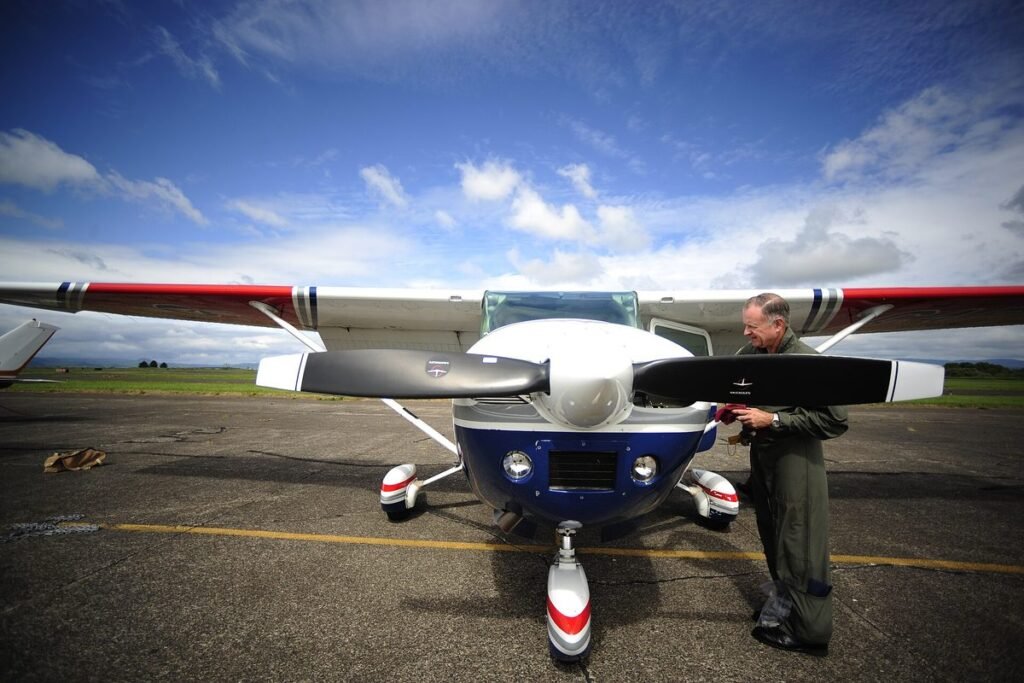

Learning how to become a pilot in the US starts with two documents, an FAA medical certificate and a student pilot certificate, followed by roughly 60 to 75 hours of flying for a private pilot certificate. Every later step stacks on that one: instrument rating, commercial certificate, flight instructor, and finally the airline transport pilot (ATP) certificate at 1,500 hours. Count on six months to a year for the private if you fly twice a week, and two to four years from zero to an airline first officer job.
Student pilot certificate and medical before your first solo
Nobody needs paperwork to fly with an instructor. A discovery flight on day one goes in your logbook as dual instruction, with no certificate in your pocket. The documents matter the day your instructor wants to step out of the airplane.
- Student pilot certificate. Minimum age is 16 for airplanes, 14 for gliders and balloons. You apply through IACRA, the FAA’s online application system, and a flight instructor, examiner or FSDO inspector checks your ID and signs off. There is no fee, the plastic card arrives by mail within a few weeks, and it has no expiration date.
- Medical certificate. Most students hold a third-class medical, issued by an aviation medical examiner (AME) after you fill out the FAA’s MedXPress form online. Expect $100 to $200 for the exam. For private flying, a third class lasts 60 calendar months if you are under 40 and 24 months from age 40.
- English. The FAA requires you to read, speak, write and understand English. The instructor confirms it during the application.
Third class, BasicMed or sport pilot: three medical routes
The third-class medical is the default, and the only one a new student can count on. Two alternatives exist, each with its own limits.
BasicMed
BasicMed replaces the AME visit with an exam by any state-licensed physician every 48 months and an online medical course every 24 calendar months. It only works if you held a valid FAA medical at some point after July 14, 2006, so a brand-new student still needs one regular medical first. Since November 2024, BasicMed covers aircraft up to 12,500 pounds maximum takeoff weight with up to seven people on board (six passengers). You stay below 18,000 feet MSL and 250 knots, and you cannot fly for compensation.
Sport pilot
Sport pilots can use a US driver’s license instead of a medical, as long as their most recent FAA medical application was not denied or revoked. The FAA minimum is 20 hours of flight time. The MOSAIC rule, in force for sport pilot privileges since October 22, 2025, widened the range of aircraft a sport pilot may fly, and night flying became possible with training, an endorsement and a medical or BasicMed. For a weekend flyer who wants a two-seater, this is the cheapest door into aviation.
Private pilot certificate: 40 hours on paper, 60-plus in practice
The private pilot license (officially a certificate) lets you carry passengers, fly at night and go anywhere in the country, as long as nobody pays you. You must be 17 to receive it. Under Part 61, the FAA minimum is 40 hours, including:
- 20 hours of dual instruction, with 3 hours of cross-country, 3 hours at night (including a 100-nautical-mile night cross-country and 10 night landings), 3 hours on instruments and 3 hours of checkride prep;
- 10 hours of solo, with 5 hours of solo cross-country and one long solo trip of 150 nautical miles with full-stop landings at three airports;
- 3 solo takeoffs and landings at an airport with a control tower.
Very few people finish at 40. Most need 55 to 75 hours, mainly because landings and radio work take longer to click than the syllabus assumes.
Two exams close the stage. The knowledge test is 60 multiple-choice questions, 70% to pass, $175 at a PSI testing center, and it stays valid for 24 calendar months. An online ground school or your instructor gives the endorsement you need to sit for it. The checkride, with a designated pilot examiner (DPE), combines an oral exam and a flight. In Redbird’s 2026 State of Flight Training report, 52% of examiners charged $800 to $1,000 for it, and the median total cost of flight training for a private certificate passed $16,000.
Instrument rating and commercial certificate
The instrument rating teaches you to fly in clouds by reference to the panel and to follow IFR clearances. Requirements under Part 61: 50 hours of cross-country as pilot in command, 40 hours of actual or simulated instrument time with 15 of them from an instrument instructor (CFII), and a 250-nautical-mile IFR cross-country with three different types of approaches. Part of those 40 hours can be simulator time in an FAA-approved training device, which costs a fraction of the airplane.
The commercial certificate is the one that allows you to be paid. Requirements include age 18, 250 hours total (190 in a Part 141 program), 100 hours as pilot in command and 50 hours of cross-country, plus a second-class medical to use the privileges. A fresh commercial pilot with 250 hours can tow banners, fly skydivers or ferry aircraft, but almost nobody hires at that level for anything bigger.
Flight instructor certificate and the 1,500-hour ATP
Most future airline pilots build their hours as a certified flight instructor (CFI). The CFI requires a commercial certificate with an instrument rating, two knowledge tests (Fundamentals of Instructing and the flight instructor test) and a checkride that examiners treat as the hardest of the sequence. A busy instructor logs a few hundred hours a year, and getting paid to fly is the cheapest way to reach the airline minimum.
The ATP certificate is required to fly as a first officer or captain at a US airline. The standard rule asks for age 23 and 1,500 hours. A restricted ATP lowers the bar at age 21:
- 750 hours for former military pilots;
- 1,000 hours for graduates of an FAA-approved aviation bachelor’s program;
- 1,250 hours for graduates of an approved associate’s program.
Before the ATP knowledge test, you must complete the ATP Certification Training Program (ATP CTP), a course with classroom work and full-motion simulator sessions. Every airline pilot also holds a first-class medical.
Part 61 vs Part 141 flight schools
Both lead to the same certificates. The difference is the rulebook the school trains under.
- Part 61 is the flexible route: independent instructors, flying clubs and small FBO schools. You schedule when you want, the syllabus adapts to you, and it suits people who fly around a job.
- Part 141 schools follow an FAA-approved syllabus with stage checks and regular audits. Minimums are lower (35 hours for the private, 190 for the commercial), which mostly helps full-time students who would fly that often anyway.
I trained Part 61 and never regretted it, but I flew around a full-time job. A student aiming for an airline seat within three years usually lands at a structured academy. ATP Flight School lists its zero-time airline career program at $123,995 in 2026, which shows the scale of the bill for the full track.
Timeline from zero hours to an airline seat
Here is a realistic calendar for someone training steadily, not a brochure schedule. Redbird’s 2026 survey put the typical private certificate at about 24 weeks.
| Stage | FAA minimum | Typical calendar time |
|---|---|---|
| Medical + student pilot certificate | Age 16 | 2 to 6 weeks |
| Private pilot | 40 h (35 h Part 141) | 4 to 12 months |
| Instrument rating | 50 h cross-country PIC, 40 h instrument | 2 to 4 months |
| Commercial | 250 h (190 h Part 141) | 3 to 9 months of hour building |
| CFI | Commercial + instrument | 1 to 2 months |
| ATP | 1,500 h (750 to 1,250 h restricted) | 18 to 30 months of instructing |
A full-time academy compresses the first five lines into about a year. A weekend learner can take three years just to reach commercial, and that is fine if the goal is flying for fun. I still use the private certificate the way most pilots do: weekend trips in a rented 172 and a $100 hamburger now and then.
FAQ
How long does it take to become a pilot?
A private pilot certificate takes about four to twelve months for most people training part-time. Reaching an airline job takes two to four years, since the ATP requires 1,500 hours. Full-time academies shorten the training part, not the hour building.
How much does it cost to become a pilot?
A private certificate typically runs $15,000 to $20,000 in 2026. The full professional track from zero to flight instructor often reaches $100,000 or more at a full-time academy, which is why many career students finance it or train part-time while working.
Can you become a pilot if you wear glasses?
Yes. A third-class medical asks for 20/40 distant vision in each eye, with or without correction, so glasses and contact lenses are fine. The certificate simply notes that you must wear them while flying.
Is there an age limit to become a pilot?
There is no maximum age to learn or to fly privately; people earn their first certificate in their sixties and seventies. The minimums are 16 for solo, 17 for the private certificate and 23 for an unrestricted ATP. Airline pilots must retire from Part 121 flying at 65.
Keep exploring
- Learn to FlyHow Much Does a Private Pilot License Cost in 2026?
- Learn to FlyBest Online Ground Schools for the FAA Written Test
- Learn to FlyDiscovery Flight: Cost
- Air TravelSeatGuru Alternatives: Where to Check Seat Maps Now
- Aviation CareersHow to Become an Air Traffic Controller
- Aviation News & MediaAviation YouTube Channels Worth Subscribing To
- Flight SimulatorsFree Flight Simulators You Can Fly Today